Learn how AI content and human content compare for SEO, rankings, trust and conversions, and discover the best approach for 2026.
AI content is now part of everyday marketing. Brands use it to draft articles, create social posts, generate product descriptions, support email campaigns and speed up research.
But the rise of AI content has created an important question for brands: does AI content perform as well as human content for SEO?
The answer is not as simple as choosing one over the other. AI content can help with speed, scale and efficiency. Human content is still essential for experience, judgement, originality, brand voice and trust.
In this guide, we compare AI content and human content for SEO, explain where each performs best and show how brands can use both effectively in 2026.
AI Content vs Human Content: What Is the Difference?
AI content is content generated or assisted by artificial intelligence tools. It can include blog posts, landing page copy, product descriptions, email drafts, social media captions, outlines and summaries.
Human content is created, edited or led by people using their own expertise, experience, judgement and creativity.
The main difference is not just who writes the words. The real difference is how the content is informed, reviewed and improved.
| Area | AI Content | Human Content |
|---|---|---|
| Speed | Very fast | Slower |
| Scale | Easy to scale | Harder to scale |
| Original Experience | Limited | Strong |
| Brand Voice | Requires guidance | Usually stronger |
| Strategic Judgement | Limited | Strong |
| SEO Value | Depends on quality and review | Depends on expertise and optimisation |
AI can help create content faster, but human input is what usually makes content useful, accurate, distinctive and trustworthy.
How AI Content Works
AI content tools generate text by predicting likely words, phrases and structures based on patterns in training data and user prompts.
This makes AI useful for producing drafts, summarising information, creating outlines and generating ideas.
AI content is especially useful for:
- Creating first drafts
- Summarising research
- Generating headline ideas
- Repurposing existing content
- Creating structured outlines
- Drafting product descriptions
- Scaling repetitive content tasks
However, AI does not automatically understand your business, customers, data, positioning or lived experience. It needs direction, editing and quality control.
How Human Content Works
Human content is shaped by knowledge, experience, context and judgement.
A human writer or strategist can understand nuance, make decisions, challenge assumptions and add original insight.
Human content is especially important for:
- Expert opinions
- Original frameworks
- Case studies
- Thought leadership
- Technical explanations
- Brand storytelling
- Content that requires trust
- Content that influences buying decisions
For SEO, human input becomes especially important when content needs to demonstrate expertise, authority and real-world experience.
AI Content vs Human Content for SEO
AI content can rank in Google if it is useful, accurate and genuinely helpful. Human content can also fail to rank if it is thin, generic or poorly optimised.
The issue is not whether content was created by AI or a human. The issue is whether the final content satisfies search intent and provides value.
For SEO, the strongest content usually combines:
- Clear search intent alignment
- Useful information
- Original insight
- Accurate facts
- Good structure
- Strong internal links
- Expert review
- Clear next steps
This is why AI-assisted content can work well when it is properly edited, fact-checked and improved by a human expert.
Does Google Penalise AI Content?
Google does not automatically penalise content simply because AI was involved.
The bigger risk is publishing low-quality, unhelpful or mass-produced content that exists mainly to manipulate rankings.
AI content can become risky when it is:
- Published without human review
- Factually inaccurate
- Generic or repetitive
- Created only to target keywords
- Lacking expertise or original insight
- Not useful to the reader
- Over-optimised for search engines
Brands should not ask, “Can Google detect AI content?” as the main question.
The better question is, “Would this content still be useful, trustworthy and valuable if a customer or search evaluator read it carefully?”
Where AI Content Performs Well
AI content performs best when the task is structured, repeatable or supported by clear human direction.
Good use cases include:
- Creating content outlines
- Drafting meta descriptions
- Generating FAQ ideas
- Summarising long documents
- Rewriting content for clarity
- Creating first drafts from expert notes
- Repurposing blog content into social posts
- Supporting keyword research and topic planning
AI can save time during the content production process, especially when used as an assistant rather than a replacement for strategy.
For example, AI might help draft a blog outline, but a human strategist should still decide the search intent, angle, structure, examples and internal links.
Where Human Content Still Wins
Human content still wins when the topic requires expertise, judgement, trust or originality.
This is especially true for brands creating content around complex decisions, expensive services, technical subjects or topics that influence customer trust.
Human input is strongest for:
- Original opinions
- Expert commentary
- Case studies
- Customer insights
- Product positioning
- Brand voice
- Strategic messaging
- Commercial judgement
AI can describe what a content strategy is. A human expert can explain why a specific strategy failed, what changed, and how to fix it.
That difference matters for SEO because search results are increasingly competitive. Generic content is easy to produce, but expert-led content is harder to copy.
AI Content vs Human Content Comparison
| Use Case | Best Option | Reason |
|---|---|---|
| First draft creation | AI-assisted | AI can speed up initial writing. |
| Expert thought leadership | Human-led | Requires original insight and judgement. |
| SEO blog outlines | Hybrid | AI can assist, but humans should shape intent and structure. |
| Case studies | Human-led | Requires real project detail and evidence. |
| Product descriptions | AI-assisted | AI can scale drafts with human review. |
| Technical guides | Hybrid | AI can help structure, but experts must verify accuracy. |
| Brand storytelling | Human-led | Requires emotional intelligence and authenticity. |
Why the Best SEO Strategy Uses Both
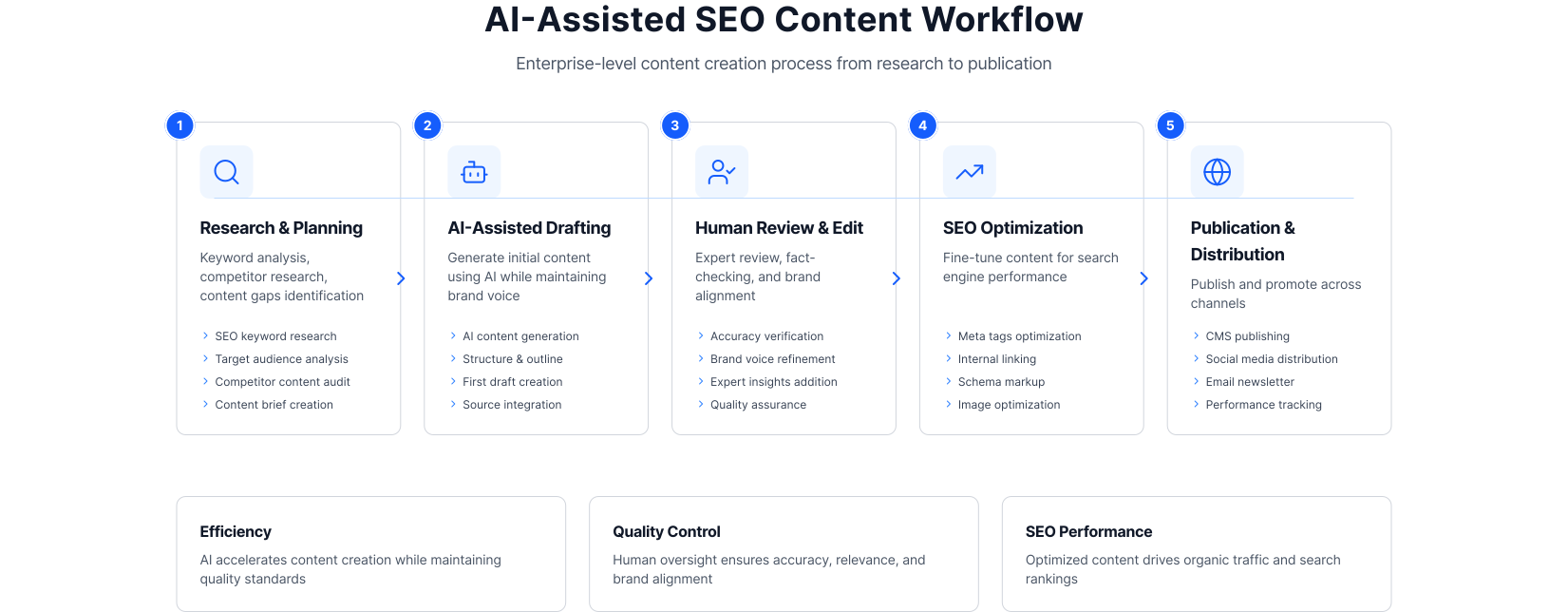
The strongest approach is not AI content or human content. It is a hybrid model.
AI can support speed and efficiency. Humans provide expertise, judgement, creativity and accountability.
A strong hybrid workflow might look like this:
Research → AI-assisted draft → Human expertise → Editorial review → SEO optimisation → Publish → Refresh
This approach gives brands the benefits of AI without sacrificing quality or trust.
It also helps content teams produce more useful content without relying on generic, unedited AI output.
How to Use AI Content Safely in 2026
Brands can use AI content safely by treating AI as part of the workflow, not the final authority.
Every AI-assisted article should be reviewed for accuracy, originality, usefulness and brand alignment.
Before publishing AI-assisted content, check:
- Is the information accurate?
- Does the article match search intent?
- Has a human expert reviewed it?
- Does it include original insight?
- Does it avoid generic filler?
- Are claims supported by evidence?
- Does it link to relevant internal pages?
- Does it help the user make a decision?
If the answer is no, the content should be improved before publication.
Common AI Content Mistakes
Many brands get poor results from AI content because they use it to produce volume instead of value.
| Mistake | Why It Hurts Performance |
|---|---|
| Publishing AI drafts without editing | The content may be inaccurate, generic or unhelpful. |
| Creating content only for keywords | The page may fail to satisfy real user intent. |
| Using the same structure as competitors | The content adds little new value. |
| Ignoring brand voice | The article can feel generic and disconnected from the business. |
| Skipping expert review | Errors or weak advice can damage trust. |
| Publishing too much low-quality content | This can weaken overall site quality. |
AI Content and E-E-A-T
E-E-A-T stands for experience, expertise, authoritativeness and trustworthiness.
AI tools can help draft content, but they cannot replace real experience.
For brands, this means AI-assisted content should still include signals of human expertise.
Useful E-E-A-T signals include:
- Author bios
- First-hand examples
- Case studies
- Original frameworks
- Clear editorial review
- Accurate internal and external references
- Practical recommendations
This is especially important for content that influences business decisions, marketing investment or technical strategy.
Is AI Content Good for SEO?
AI content can be good for SEO when it is useful, accurate, original and properly reviewed.
It is not good for SEO when it is used to mass-produce shallow pages that repeat existing information.
AI can support SEO by helping with:
- Keyword clustering
- Topic ideation
- Content briefs
- Meta descriptions
- FAQ generation
- Content refreshes
- Internal linking suggestions
However, SEO success still depends on quality. AI can help create content faster, but it cannot guarantee rankings.
AI-assisted content is also unlikely to earn links if it lacks originality or expert insight. If link building is part of your strategy, it is worth understanding what backlinks are in SEO and why genuinely useful content is more likely to be referenced.
If you want to understand how content supports rankings more broadly, read our guide on how content marketing helps SEO.
Is Human Content Better for SEO?
Human content is often better for SEO when the topic requires expertise, originality or trust.
This includes content such as strategy guides, technical explanations, service pages, thought leadership and comparison articles.
Human writers and subject matter experts can add:
- Real examples
- Commercial context
- Brand positioning
- Expert judgement
- Unique opinions
- Experience from client work
That is difficult for AI to replicate without strong human input.
How Brands Should Balance AI and Human Content
The right balance depends on the type of content and the risk of getting it wrong.
| Content Type | Recommended Approach |
|---|---|
| Social media drafts | AI-assisted with human editing |
| SEO guides | Hybrid with expert review |
| Case studies | Human-led |
| Email newsletters | Hybrid |
| Product descriptions | AI-assisted with quality control |
| Service pages | Human-led with SEO support |
| Thought leadership | Human-led |
For most brands, the safest and most effective model is human-led, AI-assisted content creation.
The Modern AI-Assisted SEO Content Workflow
A strong AI-assisted content workflow should include both technology and editorial control.
A practical workflow looks like this:
- Define the search intent
- Create a content brief
- Use AI to support research or drafting
- Add expert insight
- Edit for clarity and brand voice
- Optimise headings, links and metadata
- Fact-check claims
- Publish and monitor performance
- Refresh based on Google Search Console data
This process helps brands use AI efficiently while still producing content that is useful, accurate and trustworthy.
For technical SEO improvements, our on-page SEO optimisation guide explains how structure, metadata and internal links support rankings.
When Should Brands Avoid AI Content?
Brands should avoid relying heavily on AI when the topic requires personal experience, legal accuracy, medical judgement, financial advice or sensitive customer trust.
AI should also be avoided when the content needs a strong opinion, original research or detailed knowledge of your internal business data.
In these cases, AI can still help with structure or editing, but the substance should come from human experts.
<
Example: AI Content vs Human Content for a B2B Website
Imagine a business publishing an article targeting "SEO agency Surrey".
An AI-generated article may explain what SEO agencies do, but often repeats information already available elsewhere.
A human-led article can include local market knowledge, client experience, pricing considerations, common mistakes and real examples from Surrey businesses.
For example, a human writer may reference specific client challenges, explain why a particular SEO strategy was chosen and discuss the results achieved. These first-hand insights are difficult for AI tools to generate without direct access to real project experience.
That additional expertise creates a more useful page for users and a stronger signal of experience and authority.
The highest-performing SEO content in 2026 is rarely AI-only or human-only. It combines AI efficiency with human expertise, editorial judgement and real-world experience.
Final Thoughts
AI content and human content both have a role in modern SEO.
AI is useful for speed, scale, structure and efficiency. Human content is essential for trust, originality, experience and strategic judgement.
The brands that perform best in 2026 will not be the ones that publish the most AI content. They will be the ones that use AI intelligently while keeping human expertise at the centre of their content strategy.
For most SEO content, the best approach is not AI versus human. It is AI-assisted, human-led content.
If you want to build a content strategy that balances SEO, AI and human expertise, our digital marketing agency team can help.